90 Examples of How to Use a Contronym in a Sentence
Have you ever seen a word that means two opposite things? That kind of word is called a contronym — or sometimes a Janus word.
A contronym is tricky because it can mean one thing in one sentence and the complete opposite in another. The only way to know the meaning is by looking at the context – the words around it.
Let’s explore 90 examples with simple explanations and sentences you can understand easily.
What Is a Contronym?
A contronym is a single word with two opposite meanings.
For example:
- “Dust” can mean to remove dust — “She dusted the table.”
But it can also mean to add dust or powder — “He dusted the cake with sugar.”
Crazy, right?
English can be confusing, but learning contronyms will make you sound smarter and more confident.
90 Contronym Examples with Sentences
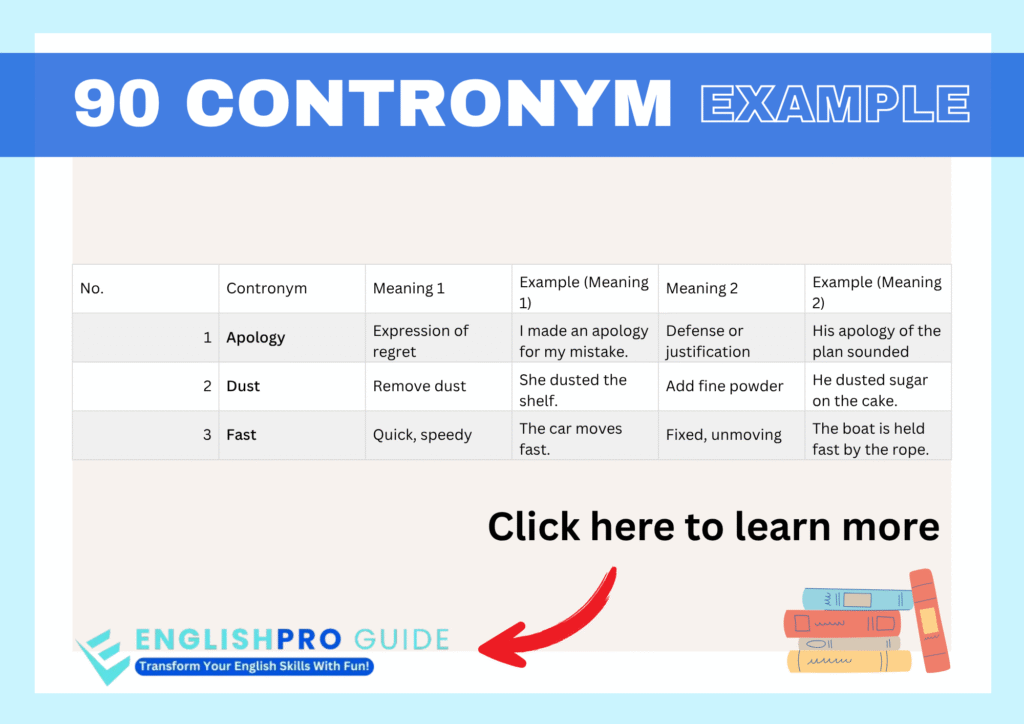
Below are 90 words that act as contronyms, each with two meanings and clear example sentences.
| No. | Contronym | Meaning 1 | Example (Meaning 1) | Meaning 2 | Example (Meaning 2) |
|---|---|---|---|---|---|
| 1 | Apology | Expression of regret | I made an apology for my mistake. | Defense or justification | His apology of the plan sounded weak. |
| 2 | Dust | Remove dust | She dusted the shelf. | Add fine powder | He dusted sugar on the cake. |
| 3 | Fast | Quick, speedy | The car moves fast. | Fixed, unmoving | The boat is held fast by the rope. |
| 4 | Bound | Going somewhere | She is bound for London. | Tied up, unable to move | The prisoner was bound with rope. |
| 5 | Buckle | To fasten | Please buckle your seatbelt. | To collapse | The bridge buckled under pressure. |
| 6 | Clip | Attach | Clip the papers together. | Cut off | She clipped her nails short. |
| 7 | Cleave | Split apart | He cleaved the wood. | Stick together | The baby cleaved to his mother. |
| 8 | Sanction | Approve | The law sanctions this action. | Penalize | The UN sanctioned the country. |
| 9 | Overlook | Supervise | She was asked to overlook the event. | Miss, fail to see | He overlooked the spelling error. |
| 10 | Screen | Show a movie | The cinema screened the film. | Hide or block | Trees screened the house from view. |
| 11 | Seed | Plant seeds | Farmers seed the field in spring. | Remove seeds | She seeded the watermelon. |
| 12 | Trim | Decorate | They trimmed the Christmas tree. | Cut off | He trimmed the edges of the paper. |
| 13 | Weather | Withstand | The wall weathered the storm. | Wear away | The rocks were weathered by rain. |
| 14 | Left | Departed | She left the room. | Remaining | Only two students are left. |
| 15 | Stone | Throw stones at | They stoned the wall. | Remove stones | She stoned the cherries. |
| 16 | Clip | Attach | I clipped a badge to my shirt. | Detach | The bird’s wings were clipped. |
| 17 | Model | To copy | The student modeled the teacher’s style. | To serve as an example | She modeled kindness for others. |
| 18 | Consult | To seek advice | I consulted the doctor. | To give advice | The expert consulted the client. |
| 19 | Trimmed | Decorated | The cake was trimmed with cream. | Cut off | He trimmed the grass. |
| 20 | Custom | Tradition | It’s our custom to visit parents on holidays. | Made to order | He wore a custom suit. |
| 21 | Hold up | Support | The pillars hold up the roof. | Delay | The traffic held up our trip. |
| 22 | Dusty | Covered with dust | The old book was dusty. | Sprinkled (lightly coated) | She baked a dusty chocolate cake. |
| 23 | Handicap | Obstacle | The injury was a handicap. | Advantage (in golf) | He started with a five-stroke handicap. |
| 24 | Left | Gone | He left early. | Remaining | One cookie is left. |
| 25 | Lease | Rent from | I lease a car from the company. | Rent to | The company leases cars to workers. |
| 26 | Off | Deactivated | Turn the light off. | Activated | The alarm went off. |
| 27 | Out | Visible | The stars are out tonight. | Extinguished | The fire is out. |
| 28 | Peer | Person of equal rank | She discussed ideas with her peers. | A noble | The peer entered the chamber. |
| 29 | Peruse | Read carefully | I perused the report. | Skim quickly | He perused the brochure before buying. |
| 30 | Present | Give | I presented her a gift. | Show or display | He will present his research. |
| 31 | Quite | Completely | The food was quite delicious. | Somewhat | The movie was quite good. |
| 32 | Refrain | Avoid doing | Please refrain from talking. | Repeat regularly | The poet refrained his line. |
| 33 | Rent | To pay for use | I rent this house. | To tear | The cloth was rent in two. |
| 34 | Rock | Move gently | She rocked the baby to sleep. | Shake violently | The earthquake rocked the city. |
| 35 | Seeded | Planted | The field was seeded in March. | De-seeded | She seeded the chili peppers. |
| 36 | Sick | Ill | He feels sick today. | Cool, amazing (slang) | That was a sick dance move! |
| 37 | Skin | Cover | He skinned the drum. | Remove skin | She skinned the potatoes. |
| 38 | Strike | Hit | The player struck the ball. | Miss (baseball) | It’s strike three! |
| 39 | Transparent | Clear, obvious | Her lies were transparent. | Invisible | The glass is transparent. |
| 40 | Trim | Add decorations | They trimmed the tree. | Cut down | He trimmed the hedge. |
| 41 | Variety | Many types | There’s a variety of fruits. | One type of a kind | A new variety of rose was planted. |
| 42 | Weathered | Survived | The company weathered the crisis. | Eroded | The statue was weathered by wind. |
| 43 | Wind up | Start | Wind up the toy. | Finish | Let’s wind up the meeting. |
| 44 | Consult | Seek advice | I consulted my teacher. | Offer advice | The expert consulted the firm. |
| 45 | Seed | Scatter seeds | He seeded the land. | Remove seeds | She seeded the apple. |
| 46 | Clip | Cut | He clipped his hair. | Attach | I clipped my ID badge on. |
| 47 | Screen | Protect | The wall screened the garden. | Show | The theater screened a new film. |
| 48 | Left | Gone | He left the class. | Remaining | Only one person left. |
| 49 | Finished | Completed | I finished my homework. | Ruined | He’s finished after that loss. |
| 50 | Go off | Explode | The bomb went off. | Stop working | The light went off suddenly. |
| 51 | Lease | Rent from | I lease this flat. | Rent to | He leases apartments to families. |
| 52 | Oversight | Supervision | The project was under her oversight. | Mistake | It was just an oversight. |
| 53 | Fix | Repair | I fixed the chair. | Make firm or still | The hunter fixed his eyes on the deer. |
| 54 | Off | Deactivated | Turn off the AC. | Activated | The alarm went off at night. |
| 55 | Out | Visible | The flowers are out. | Extinguished | The candle is out. |
| 56 | Rock | Move back and forth | She rocked the cradle. | Shake violently | The wind rocked the trees. |
| 57 | Weather | Survive | We weathered the hard times. | Worn away | The walls weathered over the years. |
| 58 | Wind | Twist | Wind the clock. | Unwind | The path winds through the forest. |
| 59 | Bathe | To wash | I bathed the baby. | To soak (something else) | The field was bathed in sunlight. |
| 60 | Clip | Attach | Clip this on your bag. | Cut | He clipped the ribbon. |
| 61 | Custom | Habit | It’s custom to greet elders. | Personalized | I ordered a custom jacket. |
| 62 | Execute | Carry out | Execute the plan. | Kill | The prisoner was executed. |
| 63 | Fine | Good | You look fine today. | Penalty | He paid a fine for speeding. |
| 64 | Fix | Repair | I fixed my phone. | Attach firmly | He fixed his eyes on me. |
| 65 | Go down | Decrease | Prices went down. | Happen | The show went down yesterday. |
| 66 | Hold up | Support | The beams hold up the ceiling. | Delay | The train was held up. |
| 67 | Inflammable | Can burn easily | Gas is inflammable. | Not able to burn (rare use) | This fabric is inflammable. |
| 68 | Lease | Rent from | We lease cars. | Rent to | They lease cars to drivers. |
| 69 | Left | Remaining | Few tickets left. | Departed | He left early. |
| 70 | Mean | Unkind | She’s mean to me. | Average | The mean score was 80. |
| 71 | Off | Canceled | The event is off. | Started | The race is off! |
| 72 | Out | Visible | The moon is out. | Extinguished | The light is out. |
| 73 | Oversight | Careful management | He had oversight of the team. | Mistake | It was a simple oversight. |
| 74 | Peruse | Read carefully | I perused the book. | Skim quickly | She perused the file. |
| 75 | Rock | Soothe | She rocked the child. | Shake | The explosion rocked the building. |
| 76 | Root | Cheer for | I’m rooting for you. | Pull up | He rooted out weeds. |
| 77 | Seed | Sow | Seed the lawn. | Remove seeds | Seed the grapes. |
| 78 | Skin | Cover | The drum was skinned. | Remove skin | Skin the fish. |
| 79 | Stone | Remove stones | Stone the fruit. | Throw stones | They stoned the wall. |
| 80 | Strike | Hit | He struck the ball. | Miss | Strike one! |
| 81 | Trip | Journey | We took a trip. | Stumble | He tripped on the rug. |
| 82 | Trim | Add decoration | The dress was trimmed with lace. | Cut | Trim your hair. |
| 83 | Weather | Survive | We weathered the storm. | Wear away | The roof weathered. |
| 84 | Wind | Turn | Wind the toy. | Wrap | The road winds through hills. |
| 85 | Consult | Ask advice | I consulted my friend. | Give advice | The doctor consulted the patient. |
| 86 | Model | Copy | She modeled his behavior. | Demonstrate | He modeled honesty. |
| 87 | Oversight | Manage | She has oversight of operations. | Miss | It was an oversight. |
| 88 | Bound | Going | The train is bound for Paris. | Tied | His hands were bound. |
| 89 | Lease | Rent from | I lease a bike. | Rent to | They lease bikes to riders. |
| 90 | Screen | Show | The channel screened a movie. | Hide | Curtains screened the view. |
Read More: 100 Sentences With The Word Her – a Common Pronoun
How to Master Contronyms
- Always check the context – The meaning depends on how it’s used.
- Learn through examples – Reading sentences like these helps you remember.
- Practice writing your own – Try using each contronym in two different ways.
- Stay curious – English loves words with double meanings!
Final Thoughts
Contronyms show how flexible and funny the English language can be.
The same word can mean to add or to remove, to move fast or to stay still.
Next time you hear one, stop and think:
“Which meaning fits this sentence?”
That’s how you grow as an English learner — one word at a time.