Collective Nouns You Didn’t Know: Take the Quiz!
Test your knowledge of collective nouns with this fun and educational quiz! Try to match the correct collective noun to each group of animals, people, or things. Answers included!
Ready to do practice? Let’s start.
Collective Nouns Quiz With Answers

100+ Examples of Collective Nouns For Our Daily Use
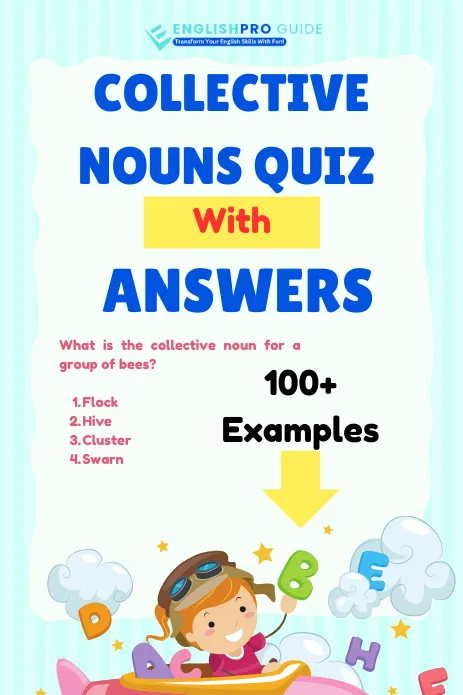
Quiz play is not enough? Here we listed 100+ samples to write and practie in your daily life. Are you ready to write?
Read More: Let’s Play Present Perfect Continuous Tense Quiz
100+ Examples of Collective Nouns
| Collective Noun | Group |
|---|---|
| Army | Soldiers |
| Band | Musicians |
| Board | Directors |
| Bunch | Grapes, Keys, or Flowers |
| Choir | Singers |
| Class | Students |
| Committee | Members |
| Crew | Sailors or Workers |
| Crowd | People |
| Flock | Birds or Sheep |
| Fleet | Ships or Vehicles |
| Gang | Thieves |
| Herd | Cattle, Elephants, or Deer |
| Hive | Bees |
| Pack | Wolves or Dogs |
| Panel | Judges or Experts |
| Pod | Dolphins or Whales |
| School | Fish |
| Staff | Employees |
| Team | Players |
| Troop | Scouts or Soldiers |
| Troupe | Performers |
| Cast | Actors |
| Colony | Ants or Penguins |
| Swarm | Insects |
| Bouquet | Flowers |
| Deck | Cards |
| Fleet | Cars or Ships |
| Shoal | Fish |
| Stack | Books or Paper |
| Gaggle | Geese |
| Bundle | Sticks |
| Set | Tools or Rules |
| Battery | Tests or Artillery |
| Litter | Puppies or Kittens |
| Clutch | Eggs |
| Plague | Locusts |
| Congregation | Worshippers |
| Parliament | Owls |
| Nest | Birds |
| Squad | Players, Soldiers, or Police Officers |
| Murder | Crows |
| Rafter | Turkeys |
| Huddle | Penguins |
| Tribe | Native People |
| Mob | Kangaroos or People |
| Flock | Sheep or Birds |
| Troop | Monkeys |
| Pride | Lions |
| Sleuth | Bears |
| Bevy | Quails or Swans |
| Brood | Chicks or Birds |
| Drove | Cattle or Pigs |
| Host | Angels |
| League | Teams |
| Parliament | Rooks |
| Rascal | Boys |
| Posse | Cowboys |
| Array | Hedgehogs |
| Convoy | Vehicles |
| Flight | Stairs or Aircraft |
| Garland | Flowers |
| Galaxy | Stars |
| Pantheon | Gods |
| Convocation | Eagles |
| Unkindness | Ravens |
| Scourge | Mosquitoes |
| Skein | Geese or Yarn |
| Cackle | Hyenas |
| Cast | Vultures |
| Crash | Rhinoceroses |
| Leap | Leopards |
| Knot | Toads |
| Zeal | Zebras |
| Coalition | Cheetahs |
| Parliament | Owls |
| Ambush | Tigers |
| Bloat | Hippopotamuses |
| Colony | Bats |
| Bale | Turtles |
| Troop | Gorillas |
| Band | Gorillas |
| Sleuth | Bears |
| Tower | Giraffes |
| Shoal | Fish |
| Parliament | Magpies |
| Rabble | Butterflies |
| Cluster | Stars |
| Bed | Flowers or Oysters |
| Bowl | Petunias |
| Bouquet | Roses |
| Cloud | Dust |
| Galaxy | Stars |
| Harvest | Crops |
| Orchard | Fruit Trees |
| Plough | Fields |
| Tuft | Grass |
| Ring | Keys |
| String | Pearls |
| Outfit | Clothes |
| Staff | Workers or Employees |
These collective nouns can be useful in everyday conversations or writing!
How to improve your Collective Nouns?
Practice with Quizzes
There are many online quizzes that can help you test your knowledge. Look for ones that not only give the answers but also explain why the collective noun fits.
Incorporate Into Writing
When writing stories, essays, or even daily journals, try to use collective nouns. This practice will help you become more comfortable using them in the right context.
Create Visual Associations
Imagine a vivid scene for each collective noun. For example, picture a murder of crows flying across a dark, stormy sky. These mental images help make the words stick.
Use Flashcards
Flashcards are a great tool for memorization. On one side, write the noun (e.g., cows), and on the other, write the collective noun (e.g., a herd). Test yourself frequently.
Hey kids! Do you have something else to say? Write down, We are here to help.