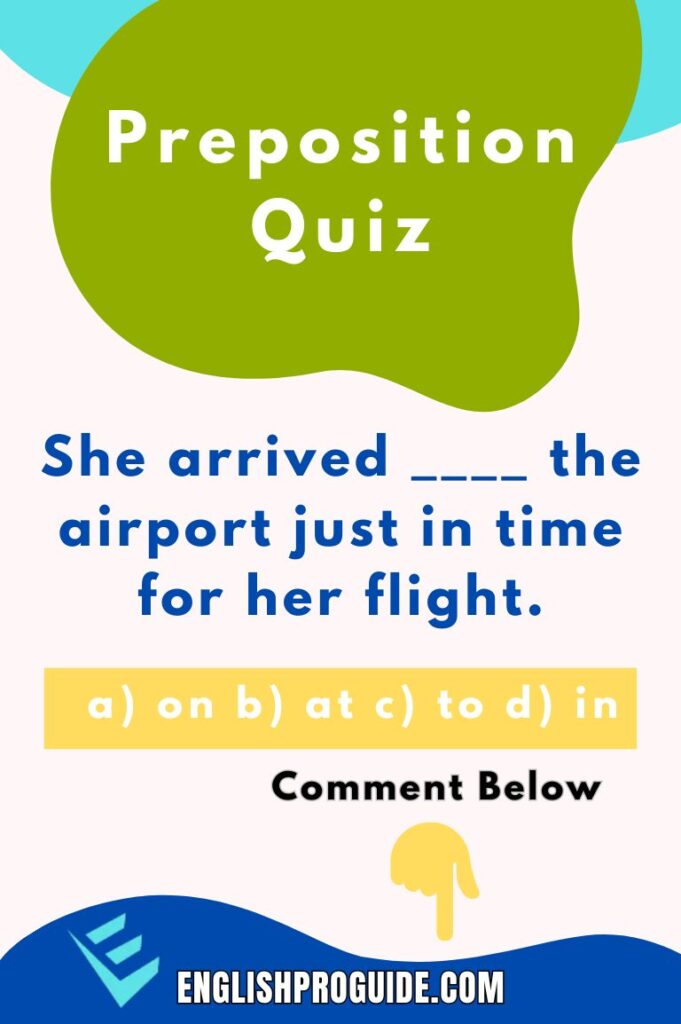
Choose the correct preposition quiz for class 7 in each question. After submitting each Preposition MCQS Quizzes you will get your result in the next window.
Prepositions: the tiny words that exposed my English the fastest
Nothing gave me away as a self-taught speaker quicker than prepositions. My grammar was solid, my vocabulary was fine, and then I’d say “I’m good in English” instead of “good at English” and a native speaker would gently wince. In, on, at, by, for — these little words have almost no logic, and class 7 is exactly when they start to matter.
For time, there’s actually a pattern worth holding onto. Think of a funnel, big to small. “In” for the largest chunks — in 2024, in May, in the morning. “On” for days and dates — on Monday, on the 5th. “At” for exact points — at 7 o’clock, at noon, at night. Big to small: in, on, at. That one image fixed half my mistakes.
Place follows a similar zoom. “In” for enclosed spaces — in the room, in Sweden. “On” for surfaces — on the table, on the wall. “At” for specific spots — at the door, at the bus stop. It’s not perfect, but it catches most of what a class 7 quiz throws at you.
Where the pattern falls apart (and you just memorise)
Here’s the honest truth no worksheet admits: a huge chunk of prepositions are pure habit, not logic. “On the bus” but “in the car.” “At school” but “in hospital” (British) or “in the hospital” (American). There’s no rule that explains why. You don’t reason these out — you collect them, like stamps, by reading and listening until the wrong one sounds wrong.
So my advice for class 7 students is the opposite of what most quizzes train: stop trying to derive every preposition from a rule. Use the funnel for time and place, then for everything else, learn the whole phrase as one unit. Don’t learn “good” and “at” separately — learn “good at” as a single chunk, the way you learned “thank you.”
The mistake I made for years: translating prepositions straight from my first language. They almost never match. “Depend on,” not “depend from,” no matter what your home language suggests.
Try the quiz above, then do this: write five sentences about your daily routine and underline every preposition. Read them aloud. Did any sound even slightly off? That faint “hmm” is your ear catching up. Which preposition trips you the most — for me it was, and still sometimes is, “at” versus “in.”